
An 8-Week Plan to Finish a 10K: From Beginner to Your First 10 Kilometers
💡 Key Summary
✅ If you can run for 30 minutes nonstop, you can finish your first 10K in 8 weeks
✅ 3–4 times a week, build up distance first, mostly at an easy pace (a conversational intensity)
✅ The average finish time for a first-timer is 60–75 minutes
If you searched for finishing a 10K, you're probably already comfortable with a 5K or 30 minutes of continuous running. This article is written for beginner-to-intermediate runners about to take on their first 10K. The goal is to cross the finish line within 8 weeks without overdoing it. We've put it all in one place — weekly training, pace management, and a race-day strategy!
1. How Is a 10K Different From a 5K?
The 10K (10 kilometers, about 10,000 m) is roughly a quarter of a full marathon (42.195 km). It's not simply double the distance of a 5K (5 kilometers). The energy system itself changes.
A 5K often ends within 30 minutes, so you can mostly get by on glycogen (carbohydrate stored in your muscles). A 10K, on the other hand, runs around 60 minutes, so in the back half you also draw on body fat. That's why pace distribution and endurance training matter far more.
What's the Average Finish Time for a First 10K?
A first-timer's finish time is usually 60–75 minutes. Organized by age and gender, the averages look like this (estimates for a first attempt).
| Age group | Men's average | Women's average |
|---|---|---|
| 20s | 55–65 min | 60–70 min |
| 30s | 58–68 min | 63–73 min |
| 40s | 62–72 min | 67–77 min |
| 50 and up | 65–80 min | 70–85 min |
At first, finishing itself is the goal rather than time. You can start worrying about your record from your second or third race.
3 Things to Know at the Start
- Keep your pace steady: Shoot out fast from the start in your excitement and you'll fall apart in the back half.
- Hydration is essential: For runs over 60 minutes, you need to drink water once or twice along the way.
- Long runs only once a week: Running long every time raises your injury risk.
2. A Pre-Start Checklist
Before you begin 10K training, check your own condition. Being able to run for 30 minutes nonstop right now is the starting line. If you're not there yet, build your base fitness first with the Beginner's Running Guide, and if the habit is lacking, start with the 30-Day Running Challenge.
A 5-Question Self-Check
- Can you run at an easy pace for 30 minutes without stopping?
- Have you kept up running twice a week or more for over a month?
- Are your knees and feet free of pain while you currently run?
- After walking fast for 10+ minutes, does your breathing quickly return to normal?
- Can you make time for exercise 3–4 times a week for 30–60 minutes?
If 4 or more of the 5 are "YES," you're ready to take on the 8-week training.
What You'll Need
- Running shoes: Shoes with 500–800 km of use have worn-down cushioning, so a new pair is recommended. For a detailed check, see the Injury Prevention Guide.
- A GPS watch or running app: For logging distance, pace, and heart rate. The Wittiz app is plenty.
- A hydration tool: For runs over 60 minutes, a handheld water bottle helps.
3. The 10K 8-Week Training Plan
The key is not increasing distance and intensity at the same time. Increasing only one a little each week is what lets you finish 8 weeks injury-free.

| Week | Frequency | Key workout | Long run | Weekly total |
|---|---|---|---|---|
| Week 1 | 3×/week | 30 min easy run × 2 | 4 km | About 12 km |
| Week 2 | 3×/week | 30 min easy run × 2 | 5 km | About 14 km |
| Week 3 | 4×/week | 30 min easy run × 2 + short intervals | 6 km | About 17 km |
| Week 4 | 4×/week | 35 min easy run × 2 + intervals | 7 km | About 20 km |
| Week 5 | 4×/week | 35 min easy run + 30 min tempo run + intervals | 8 km | About 23 km |
| Week 6 | 4×/week | 40 min easy run + 30 min tempo run + intervals | 9 km | About 26 km |
| Week 7 (taper) | 3×/week | 30 min easy run × 2 + light intervals | 6 km | About 17 km |
| Week 8 (race) | 3×/week | 20 min easy run × 2 + warm-up | 10K race | About 17 km |
Weeks 1–2: Base Building
In this phase, it's time over speed. Run everything at an easy pace (a conversational intensity). Run your long run slower than your other runs, increasing only the distance by 1 km at a time.
Weeks 3–4: Add Distance + Introduce Intervals
Your long run grows to 6–7 km. Start short intervals (alternating fast and slow) once a week. For your first interval, do just 5 sets of "1 min fast + 2 min slow."
Weeks 5–6: Pace + Tempo Runs
This is the highest-intensity phase. Introduce tempo runs (holding a pace slightly slower than race pace for 20–30 minutes) to learn the feel of your target pace. Raise the interval intensity to "2 min fast + 1 min slow."
Week 7: Tapering
Cut your weekly distance by 30–40%. Keep the intensity but reduce only the volume. Tapering (reducing your workload right before a race) recharges your body so you can run better on race day.
Week 8: Race Week
A light 20–30 min run on Monday and Wednesday, complete rest on Friday, and one of Saturday or Sunday as race day. For the 3 days before the race, don't try new foods or shoes.
⚠️ Caution
Don't increase your weekly distance by more than 10% over the previous week. Increasing distance and intensity at the same time is also a common cause of injury.
4. How to Manage Pace: Remember It in 3 Levels
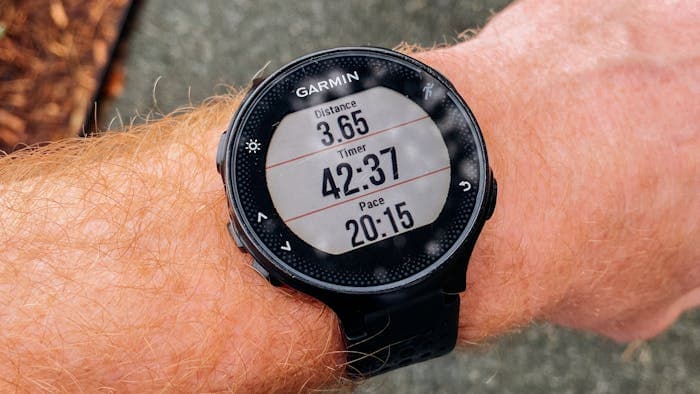
In 10K training, pace (time per km) is easier to manage when you split it into three levels.
Easy Pace (Conversational)
This is the core intensity that makes up 80% of all your training. Slow enough to chat with the person next to you — in heart rate terms, 60–70% of your max (Zone 2). If you want the diet effect too, see how Zone 2 works in the Running Diet Guide.
Long-Run Pace
A pace slightly faster than easy pace (about 10–30 seconds per km). Run your long runs at this intensity, or at an easy pace.
Target Pace (Race Pace)
Your goal 10K finish time divided by 10. For example, if your goal is a 60-minute finish, that's a 6 min/km pace. Get this pace into your body in advance during tempo runs and intervals, and you won't waver on race day.
| Target finish time | Target pace (min/km) |
|---|---|
| 50 min | 5:00 |
| 55 min | 5:30 |
| 60 min | 6:00 |
| 65 min | 6:30 |
| 70 min | 7:00 |
| 75 min | 7:30 |
💡 Tip
For your first 10K, instead of a target time, make your goal "finish at a steady pace all the way through." Going slightly slow from the start makes for a far more enjoyable race than blowing up in the back half.
5. 10K Race-Day Strategy
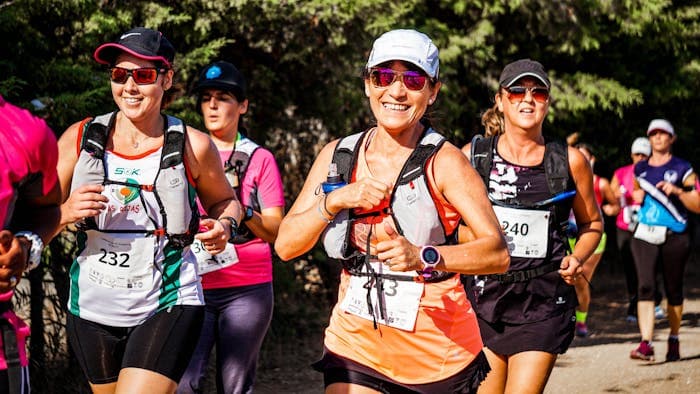
Even if your training went well, your record falls apart if your day-of strategy goes wrong. Here it is, organized by timing.
D-1 (the day before)
- Dinner: A familiar, carb-focused meal like you always eat. No new foods.
- Sleep: 7–8 hours. Even if you can't sleep, lying down and resting reduces the next day's impact.
- Gear check: Prepare your shoes, clothes, bib number, and water bottle in advance.
Morning of
- 3 hours before: A light carb meal (banana, toast, porridge).
- 1 hour before: 200–300 ml of water. If you're used to caffeine, a cup of coffee is good too.
- 30 minutes before: A 5-minute warm-up (light jog + dynamic stretching).
Pace Distribution After the Start
For a 10K, running the back half faster than the front half (a negative split) is the most stable approach.
- 0–3 km: 5–10 seconds slower than target pace. Be careful not to go fast from excitement.
- 3–7 km: Settle into your target pace.
- 7–10 km: If you have something left, take the last 1–2 km slightly faster.
If there's a water station, a sip around the 5 km mark is enough. At first, wet your mouth rather than gulping it down.
6. Common Mistakes and Injury Prevention

Here are the mistakes that happen most over the 8 weeks. Knowing them ahead of time makes them easy to avoid.
- Increasing distance and intensity at the same time: Increase only one of the two. The detailed principles are in the Injury Prevention Guide.
- Running your long run fast: Slow is the answer for long runs. Going fast raises your heart rate and carries over to your next workout.
- Doing full interval sets from day one: Start with 4–5 sets, and increase as you watch your condition.
- Ignoring pain signals: If pain anywhere — knee, shin, or sole — doesn't fade for 2–3 days or more, take a week off.
- Skipping the taper: "Wouldn't I do better if I ran more?" is the most common trap. If you don't cut the volume in week 7, your legs will feel heavy on race day.
⚠️ Caution
If knee, ankle, or shin pain persists for more than a week, stop training and consult a specialist. One overdone session can cost you all 8 weeks of training.
Try it for yourself in the Wittiz app!
Frequently Asked Questions (FAQ)
About how long is a first 10K finish time?
Most first-timers finish between 60 and 75 minutes. What matters isn't the time but running to the end without stopping. A first race isn't about chasing a record — it's a place to gain the confidence of "I can run 10 km."
Do I have to run every day?
No. 3–4 times a week is the most effective. Your muscles and joints recover on rest days and actually get stronger. Running every day instead raises fatigue buildup and injury risk.
Do I really have to do interval training?
If your goal for your first 10K is just to finish, it's not essential. You can go through 8 weeks focused on building distance and still finish just fine. That said, adding intervals once a week makes your pace faster and leaves you less worn out in the back half. If you can, try them at least from week 5.
What do I do if my knee hurts during training?
First, stop. If it's mild pain, rest 2–3 days and then restart with your distance cut by 30–50%. If it doesn't improve after a week or it hurts even when walking, see a doctor. RICE (rest, ice, compression, elevation) first-aid is covered in the Injury Prevention Guide.
What kind of event is good for a first 10K race?
Start with a low-pressure virtual running event. With no fixed time or place, you can run at your own pace on a familiar neighborhood course and even earn a finisher's medal. The WittiRun virtual race run by Wittiz is a great stage for a first attempt.
Wrapping Up
Finishing a 10K comes down to something simple: build up distance slowly over 8 weeks + mostly easy pace + rest enough in week 7. The moment you cross your first finish line, you'll feel a sense of achievement different from your 5K.
Start your first Week 1 workout today with 30 minutes at a speed you can talk through. Moongti is cheering you on!

This article was written by the Wittiz team and includes app-related content. If a medical judgment is needed, please be sure to consult a medical professional.