
Women's Running Diet: An 8-Week Weight-Loss Plan Tailored to Your Menstrual Cycle
💡 Key Summary
✅ For a women's running diet, adjusting intensity to the 4 phases of your menstrual cycle doubles the effect
✅ Light running is fine even during your period. It can actually help ease the pain
✅ For the 3 injuries common in women (IT band, pelvic floor, stress fracture), prevention up front is key
"Doing the same exercise, some weeks the weight comes off well and other weeks it goes up" — it's a frustration many women runners relate to. This article is for women runners in their 20s–40s whose condition changes with their menstrual cycle. We've put together how hormonal differences affect your diet and how to adjust your running intensity by phase, along with an 8-week plan.
1. How Is a Women's Running Diet Different From Men's?
Run the same 30 minutes and the results differ for women and men. Knowing the key differences changes your diet strategy.
| Item | Women's average | Men's average |
|---|---|---|
| Body fat percentage | 18–28% | 10–20% |
| Muscle mass ratio | Lower | Higher |
| Basal metabolic rate | 1,200–1,400 kcal | 1,600–1,800 kcal |
| Fat-utilization ability | Better | Average |
Women have a better ability to use body fat than men. It means that running at the same intensity, they can draw more energy from fat. That's why a conversational speed (Zone 2 running) suits a women's diet especially well.
But because the basal metabolic rate (the energy you use at rest) is lower, eating the same amount makes you gain weight more easily. To make up for this, strength training is essential. Gain 1 kg of muscle and you burn 13 kcal more a day.
The Myth That "Running Makes Women's Legs Thick"
It's something you hear a lot, but it's not true. Women have a hormonal environment in which muscle doesn't build easily (testosterone at about 1/10 the level). Light running won't make your legs thick. If anything, your muscles tone up and your leg lines get prettier.
2. The 4 Phases of the Menstrual Cycle and Diet Efficiency
Female hormones change on roughly a 28-day cycle. Adjust your exercise intensity to that cycle and the effect gets much better.
| Phase | Timing (from day 1 of your period) | Hormone state | Condition | Diet efficiency |
|---|---|---|---|---|
| ① Menstruation | Days 1–5 | Both estrogen and progesterone low | Fatigue↑ Pain↑ | ⭐⭐ |
| ② Follicular | Days 6–13 | Estrogen rising | Condition at its best | ⭐⭐⭐⭐⭐ |
| ③ Ovulation | Days 14–16 | Estrogen at its peak | Full of energy | ⭐⭐⭐⭐ |
| ④ Luteal | Days 17–28 | Progesterone rising | Swelling, appetite↑ | ⭐⭐⭐ |
① Menstruation (Days 1–5): Light Recovery Runs
A phase of high pain and fatigue. Don't overdo it — go slowly with a 20–30 minute recovery run (conversational speed). On days with severe cramps, it's fine to rest and start from the next day.
② Follicular (Days 6–13): The Golden Period for Dieting
As estrogen rises, your fitness, focus, and mood are all at their peak. It's the phase when high-intensity intervals, long runs, and strength training all go best. Diet results are at their biggest here, too.
③ Ovulation (Days 14–16): Watch for Injury
You're full of energy, but your ligaments stretch 30% more than usual, so injury risk is high. Keep the intensity but avoid excessive jumping and sharp changes of direction.
④ Luteal (Days 17–28): Prepare for Swelling and Appetite
Your weight can go up 1–2 kg. This isn't fat but hormone-driven water retention. Don't be shaken by the number on the scale — keep running as usual. It's also a phase when appetite rises, so you have to pay more attention to diet management.
💡 Tip
Track your cycle for 1–2 months with a period-tracking app (Clue, Knoting, etc.). Once you see the pattern of which weeks you feel good or bad, your training intensity naturally falls into line.
3. Running During Your Period — Does It Help Your Diet?
"Is it okay to run during my period?" is the question women runners ask most. To get straight to the point, at a light intensity, it actually helps.
The Good Side of Running During Your Period
- Eases cramps: Light aerobic exercise improves pelvic blood flow and reduces pain. The Korean Society of Obstetrics and Gynecology also recommends appropriate exercise.
- Improves mood: The endorphins released during exercise ease irritability and low mood.
- Better sleep quality: It helps with the insomnia common during your period.
Signs to Stop
That said, don't overdo it. If you have the following symptoms, stop immediately.
- Dizziness or headache
- A sudden increase in bleeding
- Worse-than-usual abdominal pain
- Knee or lower-back pain
On days 1–2 when flow is heavy, a short recovery run within 30 minutes is enough. From day 3, as the flow eases, you can return to 70–80% of your usual intensity.
⚠️ Caution
If irregular periods last more than 3 months, or you develop amenorrhea where your period stops after exercise, be sure to see a gynecologist. It can be a sign that excessive exercise or dieting is breaking your hormonal balance.
4. An 8-Week Cycle-Tailored Running Diet Plan
This is an 8-week plan that uses your hormonal cycle. Set day 1 of your period as the first day of Week 1 and begin.
| Week | Cycle phase | Frequency | Key workout | Strength training |
|---|---|---|---|---|
| Week 1 | Menstruation | 2×/week | Recovery run 20–30 min | Light stretching |
| Week 2 | Early follicular | 3×/week | Zone 2 run 40 min | Squats·lunges 20 min × 2 |
| Week 3 | Late follicular | 4×/week | Zone 2 40 min × 2 + interval 20 min × 1 | Full-body strength 20 min × 2 |
| Week 4 | Ovulation·early luteal | 3×/week | Zone 2 45 min × 2 + tempo run 25 min × 1 | Core 20 min × 2 |
| Week 5 | Luteal (just before period) | 3×/week | Zone 2 35 min (intensity↓) | Light strength 15 min × 2 |
| Week 6 | Menstruation | 2×/week | Recovery run 25 min | Stretching-focused |
| Week 7 | Follicular | 4×/week | Zone 2 45 min × 2 + interval 25 min × 1 + long run 6 km | Full-body strength 25 min × 2 |
| Week 8 | Ovulation | 4×/week | Zone 2 50 min × 2 + tempo run 30 min + long run 7 km | Core·lower body 25 min × 2 |
Changes You Can Expect After 8 Weeks
- Body fat down 1.5–3 kg (individual variation applies)
- Average pace improved by 30 seconds to 1 minute per km
- Reduced cramp intensity (reported by about 60% of women)
- Improved sleep quality
Rather than repeating the same exercise identically every week, letting your intensity rise and fall with your cycle is also effective for preventing a diet plateau. If you've hit a plateau, see the Plateau-Breaking Guide as well.
5. 3 Injuries Common in Women
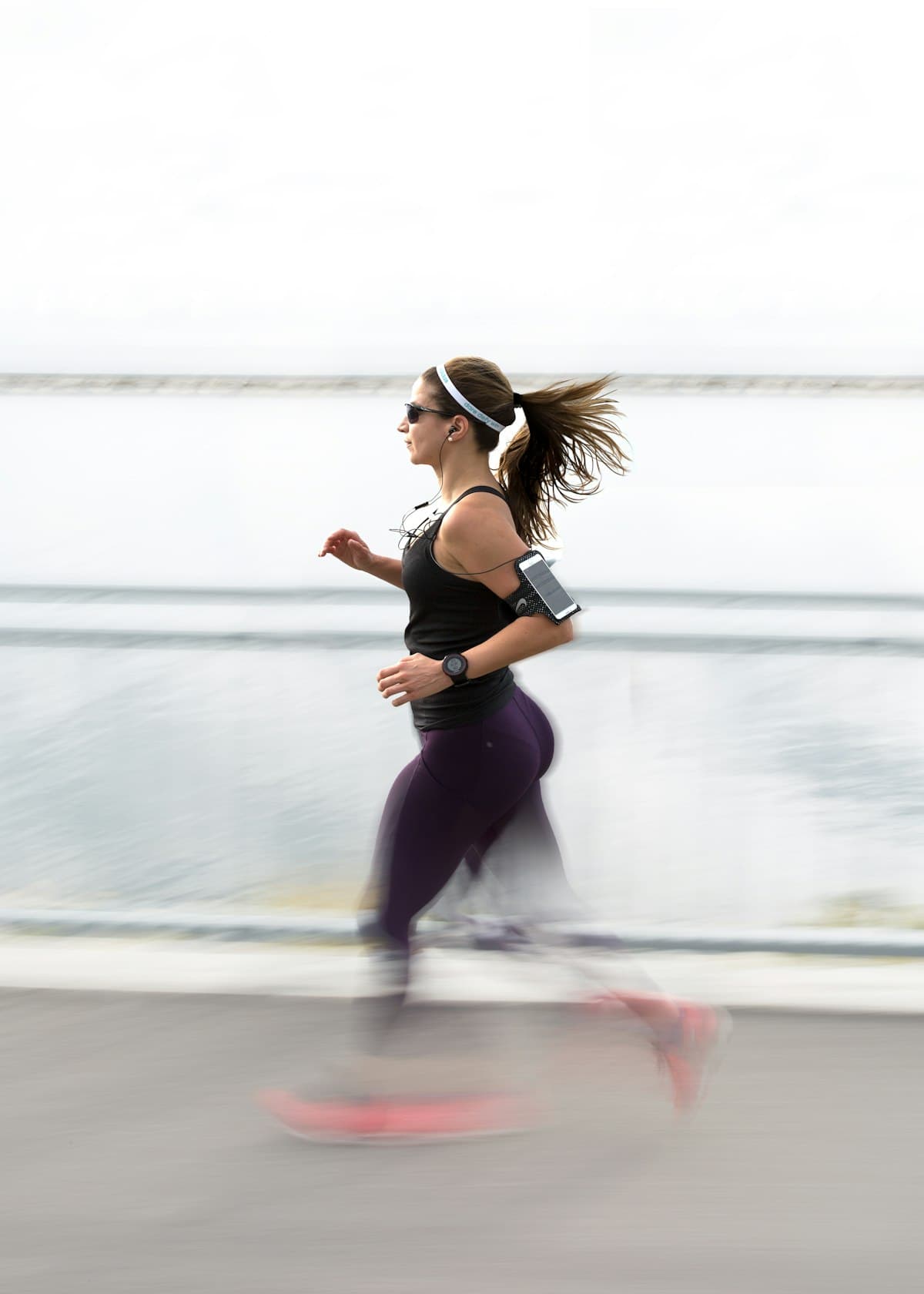
There are injuries that occur more often in women runners. It's because of differences in pelvic structure, hormones, and muscle distribution.
① Iliotibial Band Syndrome (Runner's Knee)
An injury where the outer side of the knee aches. Women have a wider pelvis, so the knee tends to bend inward, creating friction in the IT band (the ligament on the side of the thigh).
Prevention: Strengthen the muscle on the side of your hip (gluteus medius). The clamshell exercise (lying on your side and opening your knees), 15 reps × 3 sets a day.
② Pelvic Floor Weakness
Common in women who've given birth or who have a weak core. It shows up as urinary incontinence or pelvic pain during running.
Prevention: Kegel exercises for 5 minutes daily. Slowly tighten and release the pelvic floor muscles along with your breathing.
③ Stress Fracture
Women have lower bone density than men, so micro-fractures in the shin and foot occur easily after overdone running. The risk grows especially if you've cut your food intake too much for dieting.
Prevention: Get enough calcium and vitamin D + don't increase your weekly distance by more than 10%. Detailed injury prevention is in the Injury Prevention Guide.
6. Nutrition Points for a Women's Diet
These are 3 nutrients you must never run short on, even while dieting.
| Nutrient | Recommended amount (adult women) | Main foods | When deficient |
|---|---|---|---|
| Iron | 14 mg/day | Beef, spinach, beans | Anemia, fatigue |
| Calcium | 700 mg/day | Milk, anchovies, tofu | Stress fracture risk↑ |
| Protein | Body weight × 1.2 g | Chicken breast, eggs, soy milk | Muscle loss |
This is based on the Dietary Reference Intakes for Koreans. Especially during your period, iron loss is large, so you have to pay more attention than usual. Sticking to a vegetarian diet for the sake of weight loss and then collapsing from anemia is surprisingly common.
📌 Note
If during a diet you suddenly get dizzy or your nails break, it can be a sign of anemia. Handle mild supplementation with food, but if symptoms are severe, get a blood test at a hospital.
7. Safety Tips for Women Runners
Here are 5 tips for women runners running alone to safely continue their diet.
- Time of day: 5–6 a.m. or before 8 p.m. Avoid times that are too late.
- Course: Inside parks, riversides, and apartment complexes with lots of people. Avoid deserted alleys and mountain paths as much as possible.
- Clothing: At night, reflective stickers and a head lamp are essential.
- Belongings: Always hold your phone in your hand or fix it to an armband. Attaching a safety whistle to your bag is good.
- Use an app: Share your route with family or friends using a running app with location tracking and record-verification features.
Reading how to safely start your first run in the Beginner's Running Guide helps too.
Try it for yourself in the Wittiz app!
Frequently Asked Questions (FAQ)
Is it okay to run during my period? Does the pain decrease?
At a light intensity, it actually helps ease the pain. The endorphins released during exercise reduce pain, and as pelvic blood flow improves, cramps ease. But on days 1–2 when flow is heavy, keep it short with a 20–30 minute recovery run, and if dizziness or severe abdominal pain comes, stop immediately.
If my weight goes up before my period, is the diet failing?
No. In the luteal phase (the week before your period starts), hormones increase your body water by 1–2 kg. This is temporary swelling, not fat, so it comes off naturally once your period starts. Don't be shaken by the number on the scale — keep up your running and diet as usual. This is covered in more detail in the diet-plateau article.
Do women's legs get thick from running, too?
No. Women have a hormonal environment where muscle doesn't build easily (testosterone at 1/10 of men's), so light running won't make your legs thick. If anything, as body fat comes off, your leg lines get smoother and cellulite decreases. That said, short sprints where you go all out every time can thicken your thighs, so if your goal is dieting, run long at a conversational speed.
Is it okay to run while pregnant?
If you've been running regularly, light running is possible in early-to-mid pregnancy, but always consult your OB/GYN first. In late pregnancy, the strain on your pelvis and joints grows, so it's generally safer to switch to brisk walking or prenatal yoga. Starting running for the first time during a first pregnancy is not recommended.
Is there any benefit to starting running after menopause?
Yes — the benefit of running is actually greater after menopause. After menopause, bone density drops quickly, and weight-bearing running stimulates the bones, which is good for preventing osteoporosis. Start with 30 minutes of brisk walking, and once you're used to it, slowly raise the intensity with a 1-min-run + 2-min-walk interval. If your knees are weak, start somewhere low-impact like a treadmill or a track.
Wrapping Up
A women's running diet comes down to three things: adjust intensity to your menstrual cycle + mostly a conversational speed (Zone 2) + take care of strength training and nutrition (iron, calcium, protein). Use your hormones instead of fighting them, and you can see twice the results for the same effort.
Check what day of your cycle you're on today. Run long on good days and short on tough days — that rhythm creates the smile in front of the mirror 8 weeks from now. Moongti will be right there with you!

This article was written by the Wittiz team and includes app-related content. If you have irregular periods, are pregnant, or have an underlying condition, please be sure to consult a specialist such as a gynecologist before starting to exercise.